
Advocating for change in visual FX
Raqi Syed is leading an international scholarly push for better diversity and equity in the visual effects industry.
Raqi Syed, a writer, visual effects designer, filmmaker, and researcher, explores how to make meaningful change by enacting equity and diversity in technical art work and technology spanning global visual culture.
The story our most enduring myths tell us is that a great white man will fall from the sky and save us. Such stories offer audiences very little agency. For meaningful change to happen, we must re-evaluate our ideas not only of greatness, but who we perceive as embodying greatness.
Raqi Syed
Director, Miramar Creative Centre
With a focus on the visual effects industry, Raqi is interested in how the digital human encapsulates these concerns.
“A digital human means different things to different people—it can be a corporate virtual assistant, a stunt double for a film actor, and increasingly, a deep fake. The idea of a virtual human is something that scientists have been thinking about for a long time and it holds a lot of interest for visual narratives. The digital human has become a tool for storytelling.”
In this context, Raqi believes that the key question to ask is ‘who gets to be a digital human?’
“The visual effects industry is interested in the physically accurate representation of the digital human, for example its hair, skin, and performance. But the sort of person who has been represented as a digital human has mostly been white and male. The research used to create the ‘traditional’ digital human is centred around white Caucasian skin and straight hair. When we try to create a Black or brown digital human using off the shelf tools we are likely to end up with something that’s fundamentally incorrect,” she says.
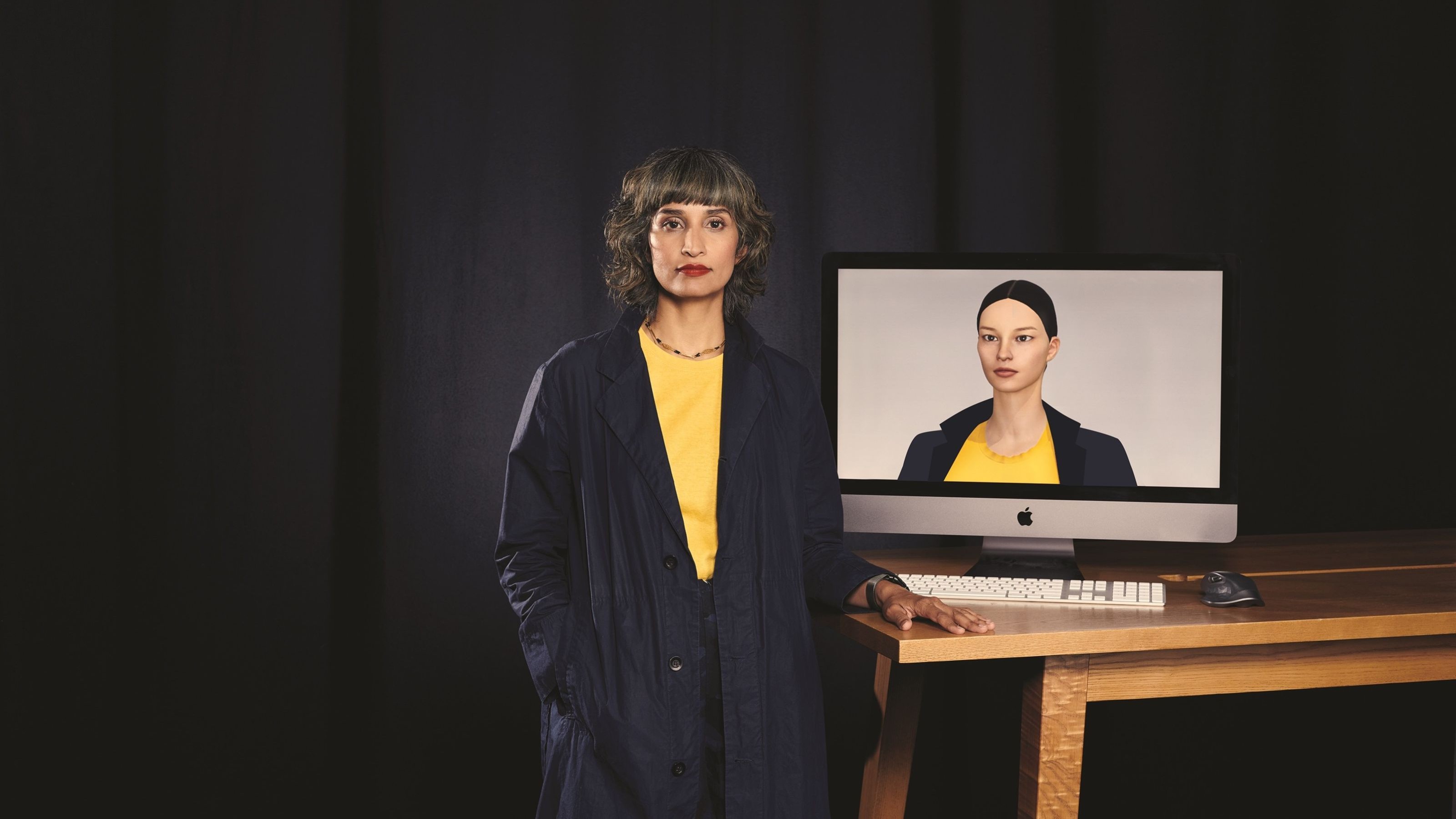
Raqi is part of a global working group of top university scholars researching bias in computer-generated imagery. She co-authored a paper for SIGGRAPH, a prestigious international computer graphics conference, that has spawned an annual discussion on what work still needs to be done to counter inherent racism in the industry. Raqi also consults with studios that contact her for advice on how to tackle unconscious bias in their work.
“The issue is still very much alive and artists are committed to addressing it—I’m doing all I can to be a part of the solution.”
Telling their own stories
Raqi started her career at Disney Animation Studios in California before emigrating to New Zealand. “I moved to Wellington and started working with Wētā FX, allowing me to learn from the best. The job is to support someone else’s story, not tell your own. While that was a key reason for me to move away from studio work, another equally important one was that when I looked around me I saw a majority of men. At that time there were no women VFX supervisors, so I saw no path forward.”
Storytelling is an important tool because it enables people to make sense of their world.
“Initially, in my lighting class, we would buy digital assets from online marketplaces and light those. But then I started working with the students to create digital humans of themselves and to think like performers and cinematographers. The results were spectacular because students are far more invested in a story world they can inhabit. The digital human becomes a vehicle for autobiography and memoir and the student becomes an embodied story designer.”
Inspiring future change-makers
Raqi believes that while the film industry has made some progress, there is a lot more work to be done around countering bias.
“The need to address racism, bias, and inequality in our film culture is part of a larger movement around social inequality. Is the technology that we use equitable? How do we dismantle entrenched power structures and distribution models? I’m heartened by our early career artists who are hungry for this change. There’s an army of designers who work below the line in VFX—we can make meaningful change by demanding equity and diversity which will flow up and outward. We can’t afford to wait for change to trickle down from the top anymore.”
The current generation is more active about advocating for change. They know the craft but they also embody the stance of a critical visual effects designer. The future of storytelling and visual effects will be anti-racist.
Raqi Syed
Director, Miramar Creative Centre
From Wellywood to the world
Raqi is based at the Miramar Creative Centre (MCC), which is located at the heart of Wellington’s moviemaking precinct. Te Herenga Waka was recently recognised by the Hollywood Reporter as one of the top 15 film schools in the world because of the MCC’s industry connections and emphasis on cultivating hands-on practical expertise for Masters of Design Technology (MDT) students.
Raqi says the University’s strength in teaching post-grad animated filmmaking is reflected by the success of students like 2024 MDT graduate, Jun Huang, whose short film End of Summer has been screening to acclaim around the world in 2025.
“I’m proud to be part of the Wellington Animation & Film Festival (WAFF) team, which has been running for several years now. WAFF has partnered with France’s Annecy International Film Festival—the biggest animation festival in the world,” she says. “Our postgrad students are receiving a world-class animation filmmaking education. These connections mean our students are getting incredible opportunities for their work to travel internationally.”
Find out more about research at Te Kura Hoahoa School of Design Innovation.